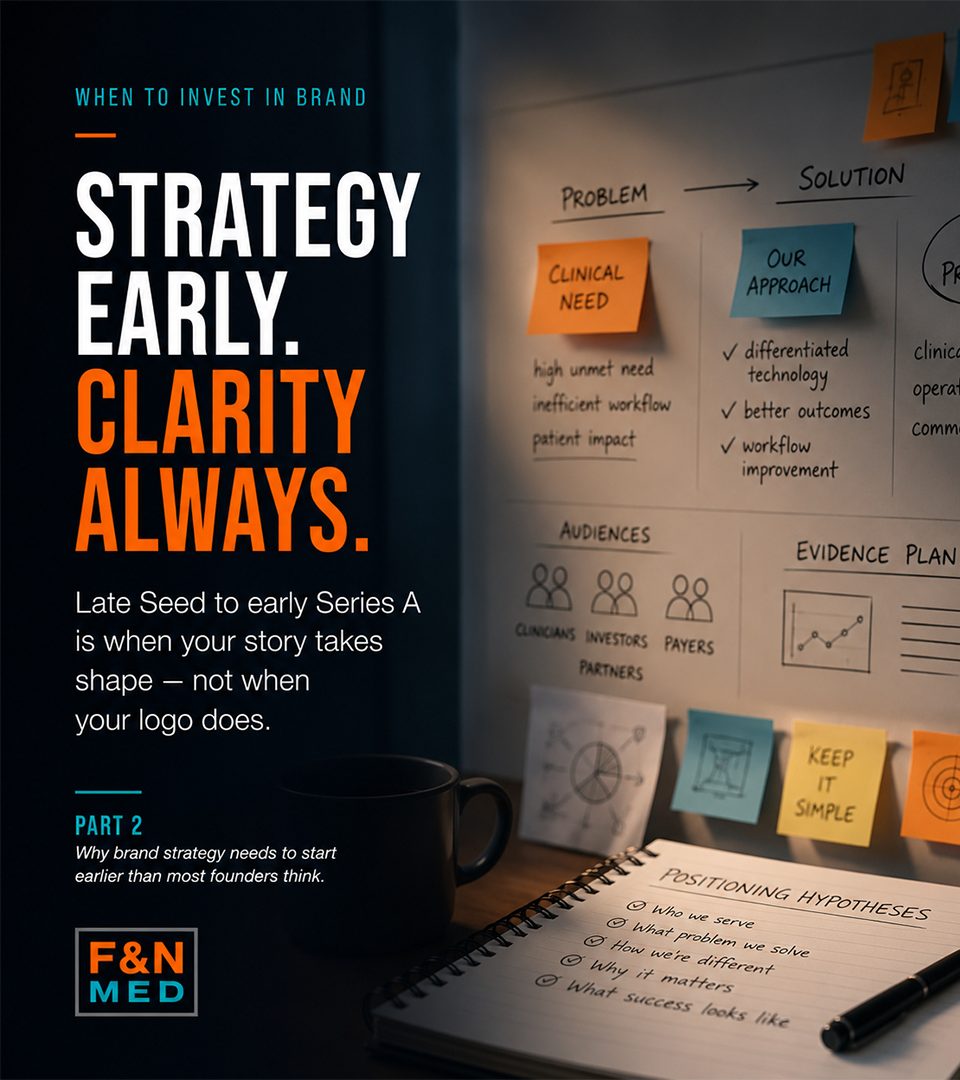
Part 2: Why Brand Strategy Needs to Start Earlier Than Most Founders Think (Late Seed to Early A)
In early-stage MedTech, “brand” doesn’t mean what most people think it means.
At late Seed through early Series A, brand strategy isn’t about a polished identity, a tradeshow booth look, or a claim-ready messaging system. It’s about clarity — the kind that helps founders articulate their value in a world of scientific nuance and investor skepticism.
At this stage, companies are working to define:
- Clinical relevance
- Category boundaries
- Early KOL engagement
- First investor conversations
- Pilot or feasibility studies
- The true nature of the problem they solve
At this point, investors and clinicians don’t expect polish. They expect coherence.
They want founders to confidently answer:
- Who are you?
- What problem are you solving?
- Why does it matter clinically and operationally?
- What makes your approach different?
- What is the commercial potential?
This is the ideal moment to build:
- Positioning hypotheses
- Persona and audience understanding
- Early messaging scaffolding
- A simple strategic narrative rooted in insight
- Exploration of visual territories (not a full identity system)
At this stage, clarity matters more than completeness.
Just as important is what you shouldn’t build yet:
- A full creative platform
- A brand identity meant for commercialization
- A claims-safe messaging hierarchy
- A production-heavy website
A lightweight strategy builds alignment, accelerates investor comprehension, and reduces costly pivots down the road.
Early MedTech teams don’t need a finished brand. They need a directionally correct story that becomes the spine of everything that follows.
Coming soon: Part 3. The Series A to Series B inflection point — when brand becomes a business enabler.